
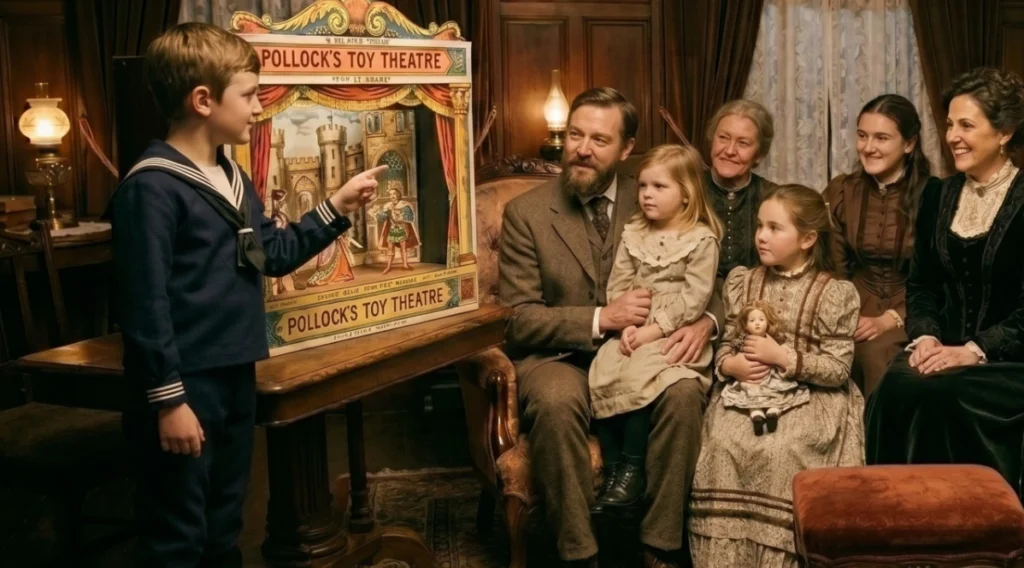
There’s a long and wonderful tradition behind the miniature stage. Toy theatres — small-scale replicas of the grand playhouses of their day — have been delighting children and adults alike for over two hundred years. They’re a window into history, a celebration of craftsmanship, and a living art form that continues to inspire makers and storytellers today. If you’ve ever wondered where tabletop theatre came from, settle in: this is a story worth telling.
The golden age: early nineteenth century Britain
The toy theatre as we know it was born in Britain in the early 1800s, at a time when the theatre was the great popular entertainment of the age. The playhouses of London — Drury Lane, Covent Garden, the Surrey Theatre — were packed night after night with audiences from all walks of life, hungry for drama, spectacle, and spectacle.
Enterprising print shop owners saw an opportunity. They began producing printed sheets featuring characters, scenery, and props from the most popular productions of the day. For a penny if you wanted them plain, or twopence if you wanted them coloured by hand, you could buy a sheet of figures from the latest sensation at the Lyceum and recreate the whole thing at home.
The phrase “penny plain, twopence coloured” was used by Robert Louis Stevenson as the title of an essay he wrote about his childhood love of toy theatres. The sheets were produced by a handful of specialist publishers, most famously Benjamin Pollock, whose shop in Hoxton became a beloved institution. Pollock’s Toy Museum in London still carries his name to this day.
How a toy theatre worked
The basic format was simple but endlessly versatile. You would buy a printed theatre — essentially a proscenium arch and stage to be cut out and assembled from card — along with sheets of characters and scenery for a specific play. The characters were mounted on stiff card and attached to thin wire or wooden rods, which allowed you to slide them on and off the stage from the wings.
Performances were a serious business in many Victorian households. Children would spend hours cutting out and colouring their figures, painting the backdrops, and learning their lines. A full production might require weeks of preparation. The result was something genuinely theatrical — with lighting effects created by candles or gas lamps, and a devoted family audience seated in respectful rows.
The plays available covered everything from Shakespeare and pantomime to the lurid melodramas that were the blockbusters of their day — tales of highwaymen, shipwrecks, and dastardly villains foiled by noble heroes. There was something for everyone, and the best productions were as eagerly anticipated as any modern box-set release.
The Victorian family parlour
It’s hard to overstate just how central toy theatre was to Victorian family life at its peak. In an era before cinema, television, or recorded music, home entertainment meant making your own. Families gathered around the parlour stage the way we might gather around a screen today — but with the crucial difference that everyone was involved in the making as well as the watching.
Toy theatres were also tools of education and aspiration. Middle-class families used them to introduce their children to great literature and drama. They taught children to read, to memorise, to project their voices, and to understand story structure. They were, in the best possible sense, improving as well as entertaining.
Famous Victorians who loved their toy theatres include Charles Dickens, who was known to stage elaborate productions for his friends and family, and the young Robert Louis Stevenson, who credited his toy theatre with sparking his lifelong love of storytelling and adventure.
Decline and survival
The late nineteenth and early twentieth centuries brought new forms of entertainment that gradually pushed toy theatre to the margins. Cinema arrived at the turn of the century, followed by radio, then television. The great print publishers of toy theatre sheets struggled to compete, and one by one most of them closed.
Benjamin Pollock’s shop survived longer than most, but even it eventually closed in the 1930s. The stock and the printing blocks were rescued and eventually led to the establishment of Pollock’s Toy Museum, which keeps the tradition alive to this day. A small but passionate community of enthusiasts — the British Puppet and Model Theatre Guild, founded in 1925, is still active — continued to make, collect, and perform with toy theatres throughout the twentieth century.
The tradition also survived in Europe, particularly in Germany, Denmark, and Spain, where toy theatres had developed their own distinctive regional styles. In these countries, the craft never entirely faded from public consciousness, and toy theatres remained a recognised part of cultural life.
The modern revival
In recent years, there has been a genuine and growing revival of interest in tabletop theatre. A new generation of makers — drawn by the combination of beautiful craftsmanship, storytelling, and the appeal of something genuinely handmade in a mass-produced world — have taken up the tradition and made it their own.
Modern tabletop theatres are more beautifully made than ever. Materials have improved, designs have evolved, and the best contemporary makers bring a level of precision and artistry to their work that would have impressed even the finest Victorian craftsmen. At Create Theatre, our 1/24 scale wooden theatres are made in Suffolk, with the same loving care and attention to detail that has always been at the heart of this tradition.
What hasn’t changed is the essential magic: the feeling of holding a whole world in your hands, of being director and audience at once, of bringing a story to life through skill, imagination, and a little bit of theatre dust.
A living tradition
The history of toy theatres is really a history of storytelling — of the human need to make sense of the world through drama, character, and narrative. That need hasn’t gone away. If anything, in a world that can feel overwhelming and impersonal, there’s something deeply comforting about gathering around a small, beautifully made stage and watching a story unfold at the touch of a hand.
The Victorian families who crowded around their parlour stages understood something important: that making stories together is one of the best things you can do. We’re carrying that tradition forward, and we’d love you to be part of it.
Join us
Create Theatre is building something special — a community of people who love theatre, storytelling, and beautiful handcrafted things. Our tabletop theatres are lovingly made in Suffolk, and we’ll be launching soon. Sign up below to be the first to hear when we’re ready.
Be part of the story — sign up for Create Theatre updates today.
Create Theatre in Your Life
www.createtheatre.com