
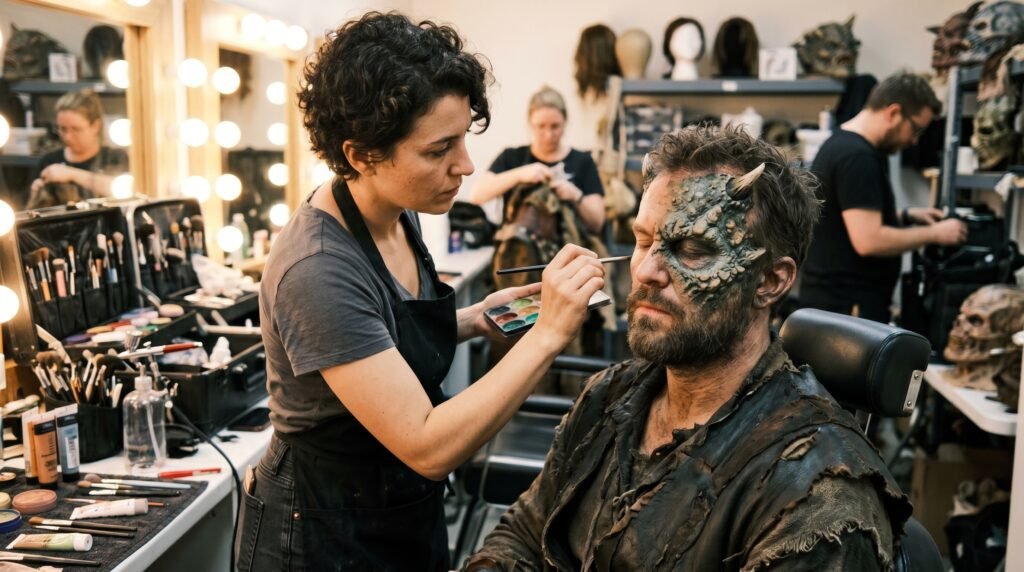
The art of transformation: makeup and prosthetics in theatre, TV and film
There is a moment, somewhere between the makeup chair and the camera or the stage, when an actor stops being themselves and becomes someone — or something — else. It might be as subtle as a few years added to the face, or as dramatic as a complete transformation into a creature that has never existed. Either way, behind that transformation is an artist whose work is as creative, as skilled, and as painstaking as anything else in the production. The makeup and prosthetics artist is, in the most literal sense, a maker of faces — and of the characters those faces belong to.
This is one of the most fascinating careers in the creative industries: a discipline that sits at the intersection of art, craft, science, and storytelling. Here is its history, its techniques, and the extraordinary range of work it encompasses today.
From white lead to foam latex: a brief history
The history of theatrical makeup is almost as old as theatre itself. Thespis, considered to be the first actor (Around 534 BC) , used white lead and wine to paint his face. In the Greek and Roman theatre that followed, actors wore masks rather than makeup, which allowed them to portray different genders, ages, and characters to audiences who might be sitting far from the stage. But as European theatre developed through the medieval period and Renaissance, the painted face returned. In the religious plays of medieval Europe, actors playing God or Christ painted their faces white or sometimes gold, while the faces of angels were coloured bright red.
On the stage of Elizabethan England, actors playing ghosts and murderers powdered their faces with chalk, and those appearing as Moors were blackened with soot or burnt cork. During the Renaissance, actors used lamb’s wool for false beards and flour as face paint. These were crude tools, but they served a purpose: to project character across the distance between stage and audience, in theatres lit by candles and oil lamps that softened and flattened every face.
The nineteenth century brought the first significant innovation in makeup technology: greasepaint. Developed originally for theatrical use, greasepaint was a mixture of lard and pigment that allowed for more nuanced and controlled application than the powders and pastes that had come before. In 1914, the iconic Max Factor developed pancake makeup — a water-based product that provided thick, matte coverage — and the foundations of modern theatrical and screen makeup were laid.
Cinema transformed everything. The camera brought the face close in a way the theatre stage never could, and the harsh early lighting of film studios revealed every imperfection in ways that demanded a new precision and naturalism from makeup artists. As film technology advanced — from black and white to colour, from studio lamps to natural light — makeup techniques evolved constantly to meet its demands.
It wasn’t until 1981 that the first Oscar for Best Makeup was awarded. Rick Baker was the first winner, for An American Werewolf in London — famous for its use of prosthetics and special effects makeup to achieve its gruesome transformation sequences. The recognition was overdue: by that point, makeup artists had been doing extraordinary work in film for decades.
The pioneers of prosthetics
Prosthetic makeup — the use of sculpted, moulded pieces applied to the face and body to physically alter an actor’s appearance — has a history almost as long as cinema itself. As early as the 1920s, Lon Chaney was transforming himself for film roles, making him known as “The Man of a Thousand Faces.” In the 1930s, makeup artist Jack Pierce and actor Boris Karloff worked together on several films where Karloff was turned into visually breathtaking monsters — including the flat-headed, bolt-necked Frankenstein that remains one of the most iconic images in cinema history.
Academy Award-winning makeup artist Dick Smith is most famous for creating SFX application methods that became the standard for Hollywood film and television, including fake blood, layered prosthetics, and foam latex for an ageing face. His work on The Godfather is a case study in subtle transformation: Smith created a dental prosthetic and used resin plumpers to make Brando’s jawline more drooped. At the time of filming, Brando was only 47 and had to sit through three hours of makeup every day so he appeared aged.
The late twentieth century saw an explosion in the ambition and technical capability of prosthetic work. Stan Winston’s creature effects for films including Aliens and Terminator 2 redefined what was possible with physical materials. Rick Baker’s lycanthrope transformations raised the bar for creature makeup. And the craft became, unmistakably, a form of art in its own right — work that could be discussed, analysed, and celebrated alongside the performances it made possible.
What makeup and prosthetics artists actually do
The term “makeup artist” covers a remarkably wide range of work, from the subtlest beauty application to the most extreme physical transformation. Understanding the different specialisms helps to appreciate just how varied the career can be.
The hair and makeup artist is the foundation of the department. On a film or television production, they are responsible for the everyday appearance of every performer in front of the camera — ensuring that continuity is maintained from shot to shot and day to day, that each character looks consistent with their established appearance, and that the overall visual world of the production is coherent. This requires organisational skill and interpersonal sensitivity as much as technical ability: makeup artists spend more time in close physical proximity to actors than almost anyone else on a production, and the relationship of trust they build matters enormously.
The special effects makeup artist — or SFX artist — works at the more dramatic end of the spectrum. SFX makeup artists use makeup and prosthetics to give performers abrasions, wounds, deformities, and animal features. They can make an actor look slightly older — or create an otherworldly monster. This work involves a completely different skill set from conventional makeup: it draws on sculpture, mould-making, painting, and an understanding of materials science that has more in common with fine art or industrial design than with cosmetics.
The prosthetic designer creates the physical pieces themselves — the foam latex appliances, silicone skins, and mechanical elements that are applied to actors’ faces and bodies. Prosthetic creation involves sculpting, moulding, and fabricating pieces such as masks, facial appliances, and body parts to achieve specific visual effects. The process begins with a life cast of the actor’s face and body, from which the artist works to sculpt the desired alteration in clay, then creates moulds and casts the final prosthetic in materials chosen for their flexibility, durability, and paintability.
The application of a complex prosthetic is itself a skilled and time-consuming process. A full facial prosthetic — the kind used to transform an actor into an alien or age them by several decades — may require four or more hours in the makeup chair before filming can begin, with the artist working in precise sequence to apply and blend each piece so that the joins are invisible on camera. The actor then has to perform — often in physically demanding conditions — while wearing a second face made of rubber, and the makeup artist must be on hand throughout the day to make running repairs and ensure the look is maintained.
The skills behind the transformation
What makes makeup and prosthetics work such a distinctive and demanding career is the breadth of skills it requires. SFX makeup artists often use skills like sculpture, painting, mould-making, digital design, and even medical science. It is genuinely a multidisciplinary practice, and the artists who reach the top of the field have typically spent years developing expertise across all of these areas.
Sculpture is perhaps the foundational skill for prosthetic work — the ability to model in clay with the precision and sensitivity to capture subtle facial features and create additions that will read as convincingly as real flesh. This is a skill that takes years to develop, and the best prosthetic sculptors are artists of considerable talent working in a very particular and demanding medium.
Painting is equally important. A prosthetic piece that is sculpted and cast with perfect technical skill will fail completely if it isn’t painted convincingly — if the colour, texture, and translucency of skin isn’t reproduced with sufficient accuracy. The finest prosthetic painters work with airbrushes, fine brushes, and specialist paints to create surfaces that can survive the merciless scrutiny of a high-definition camera in close-up. Matching the colouration of a silicone appliance to the living skin of a specific actor, under specific lighting conditions, is a genuine art.
Hair work — the creation and application of wigs, facial hair, and hairpieces — is another major component of the craft. Handmade wigs, in which individual hairs are knotted into a fine lace base, are among the most time-consuming items in any costume department, and the skills required to create them are genuinely rare. The wigmaker who can produce a period-accurate hairpiece that survives both close-up and physical performance is a valued and sought-after specialist.
Iconic transformations
Some of the most celebrated achievements in film and television history are the work of makeup and prosthetics artists. Gary Oldman’s transformation into Winston Churchill for Darkest Hour — for which the makeup designer Kazuhiro Tsuji came out of retirement specifically to take on the challenge — involved a full facial prosthetic so meticulously crafted that audiences who knew Oldman’s face had genuine difficulty recognising him beneath it. Tsuji’s work earned the Academy Award for Best Makeup and Hairstyling in 2018.
Andy Serkis’s performance as Gollum in The Lord of the Rings trilogy raised profound questions about the boundary between performance and digital effects — but what is less often discussed is that Serkis spent considerable time in physical makeup for reference work, and that the understanding of how skin, muscle, and bone interact that the makeup and prosthetics team developed was foundational to the digital artists’ work. The best modern productions understand that physical and digital effects are not competing approaches but complementary ones.
Ve Neill has been awarded three Oscars over the course of her career as a makeup artist. Her work on Edward Scissorhands was also nominated for an Academy Award. The character’s pasty white complexion was covered in scars, which Ve Neill created using sheets of ready-made scar effects stuck to Johnny Depp’s face. The simplicity of the technique belies the artistry of its application — those scars had to read as completely natural across dozens of different lighting conditions and camera angles.
Theatre: different demands, equal craft
Screen makeup and theatrical makeup are related disciplines, but they make very different demands on the artists who practise them. Where screen makeup must survive the microscopic scrutiny of a high-definition camera in close-up, theatrical makeup must read clearly from the back of an auditorium, under often extreme stage lighting that can wash out colour and flatten features. The techniques are different, the scale of application is different, and the environment is considerably less forgiving.
A theatrical makeup artist working on a large-scale musical may be responsible for dozens of performers who need to be transformed, maintained, and restored to their original appearance twice a day, eight shows a week. The speed and precision this requires — combined with the need to maintain absolute consistency across a long run — makes theatrical makeup a demanding and highly skilled specialism in its own right.
Opera and ballet present their own distinctive requirements: the conventions of makeup in these forms have developed over centuries, and an opera makeup artist working in a traditional house needs to understand those conventions as thoroughly as any other aspect of the production’s design language.
Getting into the industry
The paths into makeup and prosthetics work in the creative industries are various, but they share common elements: formal training, extensive practical experience, and the gradual building of a portfolio and professional network.
Specialist makeup schools offer courses in theatrical, film, and special effects makeup that provide the foundational technical skills — from basic beauty application and wig-making through to prosthetic sculpture, mould-making, and casting. These courses vary enormously in quality and focus, and prospective students should look carefully at the specific skills covered and the industry connections available.
Many special effects makeup artists start as freelance makeup artists or production assistants who find their way into the makeup department — most commonly as trainees and apprentices to more established artists. The apprenticeship route remains one of the most valuable ways into the industry, because it provides the combination of technical training and professional experience that no school can fully replicate. Working as a trainee on a film or television production — watching a senior artist work, assisting with preparation and application, learning the rhythms and pressures of a working set — is an education that builds skills and professional relationships simultaneously.
Beyond the mainstream film and television industry, special effects makeup artists find work across film, TV, live events, theme parks, and the medical field. Prosthetic skills developed for entertainment find direct applications in medical contexts — the making of prosthetic limbs and facial reconstructions draws on many of the same techniques as creature design. It is a reminder that the skills developed in the pursuit of theatrical transformation have value far beyond the stage or screen.
A career unlike any other
Makeup and prosthetics is one of the most genuinely creative careers the performing arts have to offer — and one of the least well understood. It combines the patience of a sculptor, the precision of a painter, the technical knowledge of a materials scientist, and the interpersonal skill of anyone who works in close and sensitive proximity to other people under pressure. Its practitioners turn the human face into a storytelling instrument, and the best of them leave traces of their work in some of the most powerful and memorable images in the history of performance.
Every transformation begins somewhere — with a first interest in how things are made, how faces work, how materials can be shaped to create an illusion. For many practitioners, that interest began early, with a costume box, a face paint set, or a sense of wonder at how completely a person could become someone else with the right tools in the right hands.
Join us
At Create Theatre, we celebrate every aspect of the art of performance — from the stories told on stage to the craft that makes those stories visible. Sign up below to join our community and be the first to hear when we launch.
Join the Create Theatre community — sign up for updates today.
Create Theatre in Your Life
www.CreateTheatre.com