
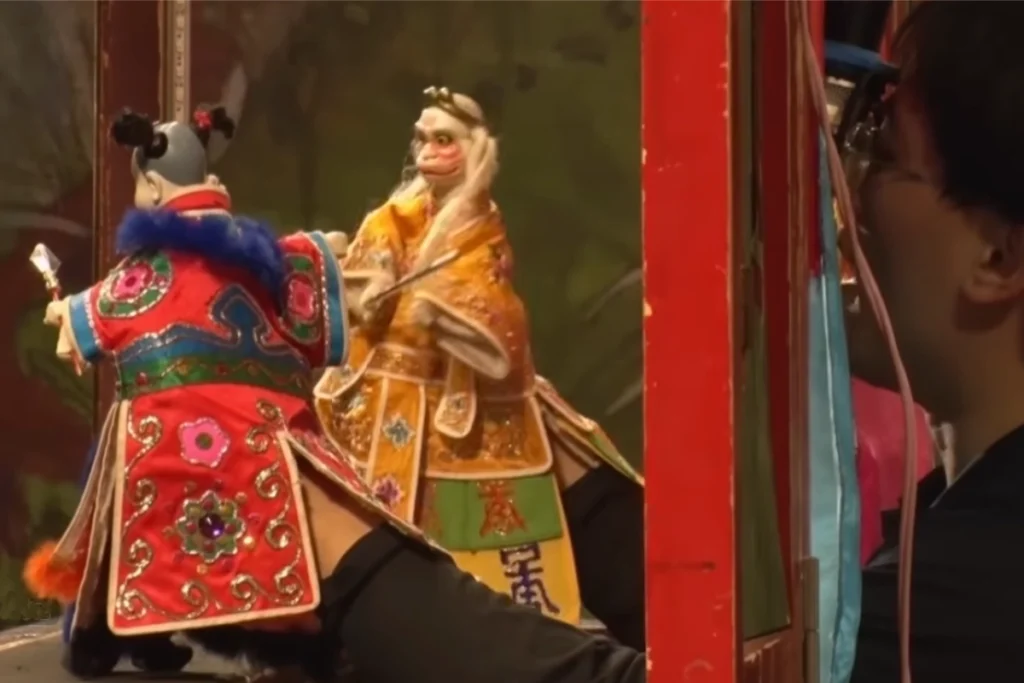
A interesting video on Bodehi can be found at: https://www.youtube.com/watch?v=3l9hhPPegkU&list=WL&index=2
Bodehi: the little theatre that carries a nation’s voice
Imagine a theatre so small that the entire stage fits in the crook of a puppeteer’s arm — and yet so powerful that when it first appeared on television, the streets of Taiwan emptied. Adults abandoned their work. Children skipped school. Entire communities gathered around screens to watch tiny figures, no more than a foot tall, enact stories of honour, adventure, and moral reckoning. That is the story of Bodehi: Taiwan’s extraordinary tradition of glove puppetry, and one of the most remarkable journeys any art form has made in the modern world.
It’s a story about survival, reinvention, and the deep human need to pass on stories in your own language. And it has something important to say to anyone who loves theatre in any form.
What is Bodehi?
Bodehi (布袋戲) translates literally as “cloth sack theatre” — a reference to the glove-like construction of the puppets, which fit over the puppeteer’s hand like a bag, with the forefinger controlling the head and the thumb and middle finger moving the arms. The Mandarin equivalent is Budaixi; in the Taiwanese language spoken by the Hoklo people, it is Bodehi. The name is humble. The art form is anything but.
Bodehi was brought to Taiwan by early immigrants from the southeastern provinces of China during the Qing Dynasty. It has since developed into a unique form of theatre infused with local style, and would later grow into one of the unofficial symbols of Taiwanese culture. The transplanted tradition took root and flourished, becoming something distinctively Taiwanese — shaped by the island’s own landscape, temperament, and turbulent history.
A typical Bodehi performance in the old days took place on a makeshift stage in front of a temple — the gathering point of every local community. The performances were the locals’ tokens of appreciation and reverence for the deities, while also being the main source of entertainment for the locals back when mass media wasn’t widely available. This dual purpose — religious ritual and popular entertainment — gave Bodehi a central place in daily life that few art forms anywhere in the world have managed to achieve.
The art of the puppeteer
The craft of Bodehi is extraordinary. A skilled puppeteer can make a glove puppet walk, run, bow, weep, and fight with a fluency that seems impossible given the simplicity of the mechanism. The puppets themselves are works of art: elaborately costumed, intricately carved, their faces painted with expressions that convey character at a glance. Heroes have open, noble faces; villains are marked by downturned mouths and calculating eyes; comic figures have a rubbery exaggeration that makes them immediately lovable.
Traditionally, a single puppeteer would operate the figures, provide the voices for all the characters, and manage the narrative — all simultaneously. The vocal performance in particular demanded a remarkable range: heroes speaking in measured, dignified tones; villains in dark, silky registers; comic characters in broad, exaggerated voices that brought the audience to laughter. This one-person, many-voice tradition gave Bodehi a distinctive intimacy: every performance was a kind of virtuoso solo act, one person holding an entire world in their hands.
Golden Ray and the television revolution
The story of how Bodehi transformed itself in the twentieth century is one of the most fascinating in the history of popular entertainment. In the fifties and sixties, to attract potential ticket holders, new stories were devised or adapted from wuxia — the martial heroes genre of Chinese fiction — which often featured fantastical plots piled with twists and turns and would usually end with a cliffhanger so that spectators would come back the next day. Elaborate props and complex stage crafts, such as moving backdrops, fluorescent-painted sets, fireworks, and electrifying lighting effects were adopted. Musical instruments accompanying the performances, such as keyboards and drum sets, replaced traditional ones to create more exhilarating music and sound effects. This was the era of Kim-kng Bodehi — Golden Ray puppetry — whose brilliant visual style transformed the art form into something dazzling and modern.
Then came television, and with it one of the most extraordinary moments in the history of any theatrical tradition. Kim-kng Bodehi took another turn and followed the popularisation of TV as it made daily appearances on the small screen. It was so popular that, once Bodehi was on the air, the streets went empty as adults and children alike halted work and school to watch. A miniature theatre, performed by hand, had become the most popular entertainment in the country. It was a triumph — and then, almost immediately, it was threatened.
Suppression and resistance
The story of Bodehi cannot be told without reference to politics — because in Taiwan, the art form and the language it’s performed in became entangled with questions of identity and power that would shape the island’s culture for generations.
These shows were so popular that the Nationalist government stopped them in 1976 on the grounds that they were distracting people from their work — but the government may also have been unhappy that the language was Taiwanese, and not the Mandarin they promoted. The ban was a cultural wound as much as an administrative decision. Bodehi wasn’t just entertainment; it was a form in which ordinary Taiwanese people heard their own language, their own idioms, their own humour and moral values expressed with full theatrical force. To silence it, was to silence something important about who they were.
And yet the tradition survived — partly through temple performances that continued regardless, and partly through a quality that is perhaps the defining characteristic of Bodehi across its entire history: the refusal to give up. Interestingly, a similar dynamic had existed during the years of Japanese colonial rule, when Taiwanese art and entertainment were discouraged from promoting themes considered overtly “local.” During this period, many Taiwanese puppet troupes would dress their puppets in Japanese kimonos, only to remove the outer garbs later in the performance — after the colonial authorities had departed — to reveal traditional Bodehi attire beneath. At that point, the dialogue would also switch from Japanese to Taiwanese. The puppets, small enough to hold in one hand, had always been harder to silence than the people who gave them voice.
Pili: when puppetry became a phenomenon
When the restrictions lifted, Bodehi came back with extraordinary force — and the vehicle for its return was a production company and television series that would become one of the most remarkable cultural enterprises in Asia. Pili (霹靂, meaning “Thunderbolt”) was the creation of the Huang family, a dynasty of puppetry masters whose contribution to Taiwanese culture is almost impossible to overstate.
Glove puppetry has long been among the brightest stars on Taiwan’s cultural scene, and the glove puppetry that everyone knows and loves the best is Pili puppetry, successor to a style created in the early twentieth century by Huang Hai-dai. Regarded by many as a national treasure, Huang handed the art down to his son Huang Chun-hsiung, who took the ball and ran with it, creating puppet characters known to virtually everyone in Taiwan. Then the art form continued into a third generation, developed into the Pili style under the able stewardship of the brothers Chris and Vincent Huang.
Based in Yunlin, Pili built the largest puppet film studio in the world, utilising new techniques to enhance their puppet empire. Combining Bodehi puppets with computer technology and 3D animation, the Pili series brought the evolution of Taiwanese glove puppetry to a new dimension. Pili has been highly successful financially and is even listed on the Taipei Exchange. Pili DVDs are sold in convenience stores across Taiwan, and images of its popular characters are used to promote everything from shampoo to alcohol. The TV series at its peak reached over 90% viewership. A glove puppet show had become a national institution.
The language question
At the heart of the Pili phenomenon — and at the heart of what makes Bodehi more than entertainment — is language. The glove puppetry series is dubbed in Taiwanese, requires pleasant and melodious pronunciation, and has a unique tradition of one person dubbing. With more than 30 years of experience, Vincent Huang has dubbed more than 4,000 characters in the glove puppetry series.
This matters enormously. Taiwanese Hokkien — the language in which Bodehi has always been performed — came under severe pressure during decades of Mandarin-only policy. The generation that grew up under those policies often speaks Mandarin as their primary language, and the number of fluent Taiwanese speakers has declined sharply. The concern is not merely linguistic; it is cultural. A language carries within it a particular way of seeing the world — a set of idioms, jokes, proverbs, and expressions that don’t translate, that belong to the people who developed them over centuries.
Bodehi, performed in Taiwanese, is one of the few places where the language is heard in full, expressive, dramatic form — not as a heritage curiosity but as a living vehicle for story, emotion, and character. For many younger Taiwanese, the Pili series has been their primary point of contact with the language. They may not speak it at home or use it at school, but they have heard it used with beauty and power on the puppet stage — and that exposure matters.
The young find their way back
Perhaps the most heartening development in the recent story of Bodehi is the growing interest among young Taiwanese — a generation that might, in theory, have been expected to abandon a tradition so thoroughly rooted in an older world.
The Pili series has played a central role in this. Its combination of elaborate fantasy narratives, complex characters with devoted fan followings, and production values that rival any animation studio has made it genuinely compelling to younger audiences. Online streaming has extended its reach beyond Taiwan to a global diaspora of enthusiastic fans. Characters from the series appear in manga, fan fiction, video games, and cosplay events. What began as a traditional puppet performance has become a fully fledged media universe, and a generation of young Taiwanese have grown up inside it.
In the past two decades, for survival or to preserve a heritage that was once an inseparable part of people’s lives, many Bodehi practitioners have been trying to keep the tradition running while reinventing Bodehi as an art form. They have stepped out of the makeshift stages into unconventional black-box theatres and proscenium stages, and started to reimagine Bodehi in terms of performativity and spectatorship. Productions have incorporated contemporary dance, live music, and theatrical techniques that draw on global performance traditions while remaining rooted in the distinctively Taiwanese art form that gave them birth.
New troupes, many led by young artists, are performing at international puppetry festivals, in galleries and arts centres, and online. They are finding audiences that their predecessors could not have imagined — and in doing so, they are making the argument, with every performance, that Bodehi is not a relic. It is a living form.
What Bodehi teaches the world about theatre
For those of us who love theatre in all its forms, the story of Bodehi is both inspiring and instructive. It demonstrates, with unusual clarity, something that is easy to forget: that the power of theatre has nothing to do with scale. The Bodehi stage is small enough to carry under one arm. Its puppets fit in the palm of a hand. And yet it has emptied streets, defied colonial suppression, outlasted government bans, and kept a language alive through its darkest hours.
It demonstrates, too, that tradition and innovation are not enemies. Bodehi has reinvented itself continuously across its history in Taiwan — from temple forecourts to television studios, from live performance to CGI, from local folk art to international cultural export — without losing the essential qualities that make it what it is. The puppets are still operated by hand. The stories still turn on honour, loyalty, and the conflict between personal desire and moral obligation. The language is still, at its heart, Taiwanese.
And it demonstrates, perhaps most powerfully of all, that a miniature theatre can carry the weight of a culture. The stories a community tells about itself, the language in which it tells them, the hands that bring the characters to life — these things matter. They are how a people knows itself across time.
That is a lesson for any stage, however small.
Join us
At Create Theatre, we believe in the power of small stages to tell big stories. Our handcrafted tabletop theatres are part of a global tradition of miniature theatre that stretches from the Victorian toy theatres of Britain to the glove puppet stages of Taiwan — and we’d love you to be part of it. Sign up below to join our community and be the first to hear when we launch.
Join the Create Theatre community — sign up for updates today.
Create Theatre in Your Life
www.CreateTheatre.com