
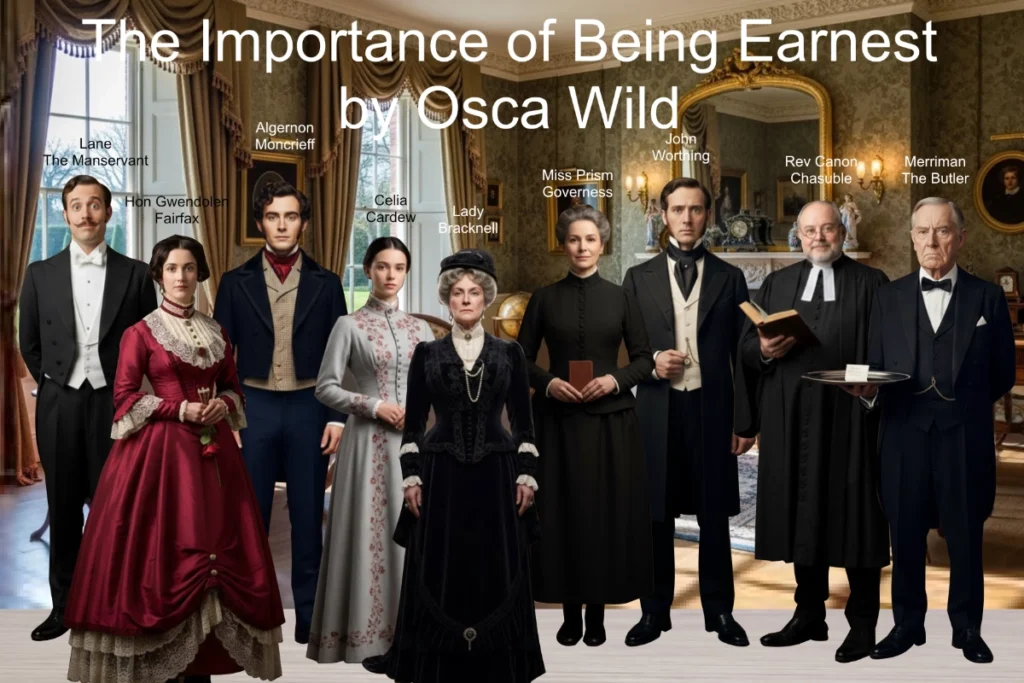
The Importance of Being Earnest: a guide for first-timers
If you’ve never read or seen The Importance of Being Earnest, you’re in for one of the great theatrical pleasures. Oscar Wilde’s most celebrated comedy is a play that makes everything look effortless — the wit flows so naturally, the plot spins so elegantly, and the whole thing is so relentlessly amusing that it can seem like it simply fell into being, fully formed and perfect.
It didn’t, of course. Behind the apparent ease lies a masterwork of construction, a razor-sharp satirical intelligence, and a playwright who understood human nature — particularly its vanities — with almost uncomfortable precision. This guide is here to help you appreciate all of that, whether you’re coming to the play for the first time or returning to it after years away.
The story, briefly
The play centres on two young men — Jack Worthing and Algernon Moncrieff — who have each invented a fictional alter ego to escape their social obligations. Jack has created a troublesome younger brother called Ernest, whose constant scrapes give him an excuse to leave his country estate and head to the excitement of London. Algernon has invented a permanently ill friend called Bunbury, whose fictional ailments allow him to escape any unwanted social engagement.
Both men fall in love. Jack wants to marry Gwendolen Fairfax, Algernon’s cousin. Algernon, in a wonderfully impudent piece of imposture, travels to Jack’s country estate under the name Ernest and promptly falls in love with Jack’s ward, the charming Cecily Cardew. Both women, it emerges, have always dreamed of marrying a man named Ernest — which creates complications that Wilde wrings for every last drop of comic potential.
The plot is driven by misunderstandings, mistaken identities, and a series of revelations that somehow manage to be both completely surprising and utterly inevitable. It resolves in a finale of such cheerful absurdity that audiences have been laughing at it for over a hundred years.
What makes it so funny?
Wilde’s comedy operates on several levels at once, which is part of why it works so well for such a wide range of audiences. On the surface, it’s a farcical plot of mistaken identity and social confusion — the kind of thing that has been making audiences laugh since ancient Greece. But underneath that is something more pointed: a sustained, gleeful demolition of Victorian social conventions, moral hypocrisy, and the gap between what people say and what they actually mean.
The dialogue is the key. Wilde’s characters speak in epigrams — perfectly turned phrases that flip conventional wisdom on its head with elegant precision. “The truth is rarely pure and never simple,” says Algernon. “I never travel without my diary. One should always have something sensational to read in the train.” These aren’t just jokes; they’re observations about the way polite society uses language to say the opposite of what it means. Every line is doing double work.
What’s also remarkable is that the characters are entirely in on the joke. Jack and Algernon know perfectly well that they’re behaving absurdly; Lady Bracknell knows that her social pronouncements are preposterous. The comedy comes from their determination to maintain the forms of respectable behaviour even when everything around them is collapsing into farce. It’s a very British kind of humour, and Wilde plays it to perfection.
Lady Bracknell: one of theatre’s great creations
No introduction to The Importance of Being Earnest would be complete without particular mention of Lady Bracknell, who is widely — and rightly — regarded as one of the great comic creations of the English stage. She is formidable, magnificent, and utterly without self-awareness. Her interview with Jack, in which she subjects him to an interrogation designed to establish his suitability as a husband for Gwendolen, is one of the funniest scenes in theatrical history.
Her reaction to discovering that Jack was found as a baby in a handbag at Victoria Station — “A handbag?” — is perhaps the most famous single line in English comedy. It works because of the perfect pitch of Wilde’s writing and the way it captures Lady Bracknell’s priorities: not horror at the situation itself, but outrage at the social impropriety of it. The substance doesn’t matter; the form is everything. That is, in a single line, the entire satirical point of the play.
The play and society
Wilde wrote The Importance of Being Earnest in 1895, at the height of his fame and just months before his catastrophic fall from grace. It was first performed at the St James’s Theatre in London on 14 February 1895, and was an immediate success. Wilde was at that moment the most celebrated playwright in London — and also, though he couldn’t yet know it, on the verge of ruin.
The play’s target is the Victorian upper class, whose elaborate social codes, rigid hierarchies, and obsession with respectability Wilde found both fascinating and absurd. He understood this world intimately — he had charmed his way to the top of it — and that intimacy gave his satire its edge. He wasn’t attacking from the outside; he was laughing from within.
More than a century later, the satire still lands. The gap between social performance and reality that Wilde identified hasn’t gone away; it’s just moved. The particular forms of Victorian hypocrisy that he skewered have been replaced by new ones, but the underlying dynamic — people performing virtue while pursuing self-interest — is timeless. That’s why the play still feels fresh.
Performing it at a tabletop theatre
The Importance of Being Earnest translates beautifully to a tabletop theatre. Its relatively small cast, its clearly defined scenes, and its reliance on dialogue rather than physical spectacle make it ideal for an intimate stage. The drawing rooms and country houses of the play — with their careful arrangements of furniture, their period details, their social geography — are perfect subjects for miniature scenic design.
And the wit of the dialogue, when delivered by a skilled performer — even a young one, at a tabletop — comes through with remarkable force. There’s something about the intimacy of a small stage that suits Wilde perfectly: you’re close enough to the characters to feel the full sharpness of each line, and the scale of the production never distracts from the words.
At Create Theatre, our production of The Importance of Being Earnest comes with everything you need to bring this classic to your own stage. It’s a perfect introduction to Wilde, to theatrical comedy, and to the joys of tabletop theatre.
Ready to raise the curtain?
Whether you’re a lifelong theatre lover or discovering Oscar Wilde for the first time, The Importance of Being Earnest is a play that rewards every encounter. And there’s no better way to encounter it than on your own stage, in your own hands.
Sign up below to be the first to hear when Create Theatre launches — and take your first step onto a stage that’s entirely your own.
Join the Create Theatre community — sign up for updates today.
Create Theatre in Your Life
www.CreateTheatre.com