
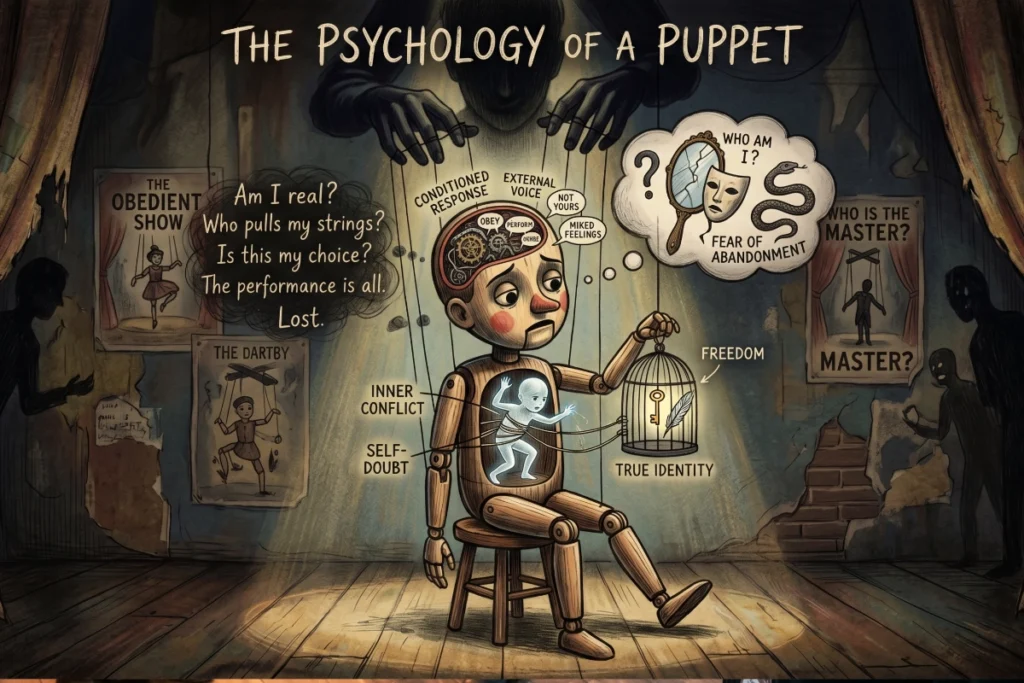
The psychology of a puppet: why we believe in something we know isn’t real
Here is something strange. You are sitting in a theatre, or around a kitchen table, watching a small figure made of wood, fabric, and paint. You know perfectly well that it is made of wood, fabric, and paint. You can see, if you look, the hand inside it, or the strings above it, or the rod that moves its head. Nothing about the situation should produce any emotional response beyond mild appreciation for the craft involved.
And yet the puppet weeps, and you feel something catch in your throat. The puppet is threatened, and your pulse quickens. The puppet dies, and children in the audience cry real tears. Something is happening that shouldn’t, by any rational account, be happening at all.
The psychology of the puppet — why human beings invest emotional reality in objects they know to be objects — is one of the most fascinating questions in the psychology of performance. It touches on how we process identity, empathy, and belief; on the strange relationship between what we know and what we feel; and on something fundamental about the human need to find life in the things around us. Understanding it illuminates not just puppetry but theatre, storytelling, and the imagination itself.
The willing suspension of disbelief — and why it’s not quite right
The standard explanation for our emotional response to fiction — on stage, on screen, or in a novel — is the concept of the “willing suspension of disbelief,” a phrase coined by the poet Samuel Taylor Coleridge in 1817. We choose, temporarily, to set aside our knowledge that what we’re watching isn’t real, and in that suspended state we respond to it as if it were.
It’s a useful phrase, but it may not be quite right — or at least, it may not fully explain what happens with puppets. Because in many forms of puppetry, the audience isn’t asked to pretend the puppet is real. The puppet’s artificiality is entirely visible, entirely acknowledged. We can see the puppeteer. We can see the strings. We know, we have always known, that we are watching a constructed object being manipulated by a human being. And we respond emotionally anyway.
This suggests something more interesting than simple suspension of disbelief: we are capable of holding two contradictory states simultaneously. We know the puppet is not alive. We also, in some meaningful sense, believe that it is. Both of these things are true at the same time, and they don’t cancel each other out. Psychologists call this capacity “dual processing” — the ability to maintain different models of reality in parallel, and to move between them fluidly depending on what the situation demands.
Children are particularly good at this, which is why they respond so intensely to puppets. But adults do it too — and the fact that adults who know perfectly well they’re watching a glove puppet can still feel genuine distress when that puppet is threatened is evidence that the capacity for this kind of double consciousness is fundamental to human psychology, not a childish weakness that sophistication should overcome.
Animism: the ancient instinct
The deep root of our response to puppets lies in something psychologists call animism — the tendency to attribute life, intention, and agency to non-living things. It is one of the oldest and most universal features of human cognition, present across all known cultures and detectable in children from the earliest months of life.
Babies as young as six months show preferential attention to objects that appear to move with intention — that seem to be going somewhere, pursuing a goal — over objects that move randomly. By the age of two, children are readily attributing mental states to objects, narrating the feelings and intentions of toys, cars, and clouds with complete conviction. This isn’t ignorance; it persists well into and beyond adulthood. Most adults will apologise to a piece of furniture they’ve walked into. Most adults feel a pang of guilt when they throw away a childhood toy. Most adults, watching a robot struggle with a task, will experience something that resembles concern.
This animistic instinct served important evolutionary functions: in a natural environment full of genuine threats, the tendency to treat any moving object as potentially intentional — potentially pursuing you — was a survival advantage. It is far better to mistake a shadow for a predator than to mistake a predator for a shadow. We are, in this sense, wired to find life. The puppet exploits this wiring with extraordinary efficiency.
The triangle of attention
One of the most revealing observations about how puppetry works psychologically is what happens when a puppet appears to look at something. When a puppet’s head turns towards an object — a door, another character, a prop — the audience’s attention follows. We look where the puppet looks. We share its point of view.
This effect is so reliable that experienced puppeteers consider it one of their most powerful tools. Direct the puppet’s gaze and you direct the audience’s attention. Make the puppet appear to notice something and the audience will notice it too, charged with the puppet’s apparent interest or concern. The puppet becomes, in effect, a guide through the visual field of the performance — and we follow because we have, unconsciously, accepted its perspective as a valid perspective, its attention as real attention.
This triangulation of attention — puppeteer, puppet, audience — is unique to puppetry among the theatrical arts. An actor can direct our attention by looking at something, but we are also aware of the actor as a person with their own life outside the performance. The puppet has no life outside the performance. It exists entirely in the present moment of the story, which gives its attention a peculiar completeness and intensity that a human performer can rarely match.
The uncanny valley — and why puppets mostly avoid it
In 1970, the Japanese roboticist Masahiro Mori described what he called the “uncanny valley” — a phenomenon in which our positive emotional response to humanoid figures increases as they become more realistic, up to a point. Beyond that point, as a humanoid figure becomes almost but not quite convincingly human, our response flips from positive to deeply unsettled. The almost-human is more disturbing than the clearly non-human, because its imperfections register as something wrong rather than something different.
The uncanny valley explains why certain realistic humanoid robots, and certain kinds of computer-generated human faces, produce feelings of unease rather than warmth. But it also explains, in reverse, why most traditional puppet forms are so psychologically effective. Glove puppets, marionettes, shadow figures, and Bunraku puppets are all clearly, unambiguously not human. They don’t attempt to pass. Their humanity is metaphorical, not imitative — and because we are not trying to resolve them into real people, we can accept them on their own terms without discomfort.
The puppet is most effective not when it most closely resembles a human being, but when it most clearly embodies a human quality — grief, joy, determination, longing — in a form that is stripped of everything else. The exaggeration and simplification of the puppet face, far from being a limitation, is one of its psychological strengths: it presents the essence of an emotional state without the complexity and ambiguity of a real human face. A puppet that weeps has nothing on its face but weeping. That clarity is extraordinarily powerful.
Projection and the empty face
Ask any experienced puppeteer what happens when a puppet is still, and they will tell you something surprising: the audience fills the stillness with meaning. A puppet that pauses after a difficult line appears to be absorbing what it has heard. A puppet that holds its position while another character speaks appears to be listening, processing, responding internally. The audience projects an inner life onto the puppet’s immobility, and that projected inner life is often richer and more emotionally affecting than anything the puppet could actively do.
This is the phenomenon that Jim Henson described when he observed that a puppet’s power lies in what it doesn’t do as much as in what it does. The still face of Kermit the Frog at a moment of emotional vulnerability — unchanged, unmoving, and yet somehow radiating feeling — is one of the most psychologically sophisticated achievements in the history of performance. It works because we project. We see ourselves in the blankness.
This projection is not passive. It is an active, creative act on the part of the audience — a contribution to the performance that the puppeteer invites and the audience makes willingly. The puppet is, in this sense, a collaborative creation: the puppeteer provides the physical form and movement, and the audience provides the inner life. The performance happens in the space between them.
This is also why people form genuine attachments to puppets — to specific figures, specific characters — in a way that can feel disproportionate to their nature as objects. What we have projected into a puppet is partly ourselves: our own experiences of grief, joy, longing, and fear, recognised in the puppet’s simplified expressions and given back to us in a form that feels safe to feel. The puppet holds what we have put there. No wonder we become fond of it.
The puppeteer’s paradox
For the puppeteer, the psychology is almost the reverse of what the audience experiences — and yet it converges on the same place. A skilled puppeteer does not try to control every movement of the puppet deliberately and consciously. That produces exactly the mechanical, lifeless performance that breaks the audience’s belief. Instead, they internalise the puppet’s character so thoroughly that they stop thinking about the puppet as an object to be manipulated and begin thinking as the character.
This is what experienced puppeteers describe as “living through the puppet” — a state in which the performer’s emotional and imaginative life flows into the figure so completely that the movements become natural rather than calculated. The puppet’s grief is real grief, briefly; the puppet’s joy is real joy. The puppeteer has become an actor, with the puppet as their body.
This is not very different from what happens in any good acting. The best actors don’t indicate emotions; they experience versions of them, and those experienced emotions are what the audience perceives as real. The puppeteer who lives through their puppet is doing the same thing — the object in their hands is simply a more visible expression of the process of becoming someone else.
The paradox is this: the more completely the puppeteer forgets that they are operating an object, the more convincingly the object appears to be alive. The puppet’s life is directly proportional to the puppeteer’s self-forgetting. That is a profound insight about performance — and about the nature of creative imagination more broadly.
What children understand that adults forget
Children are, as we noted, exceptionally good at the double consciousness that puppetry requires. They know the puppet isn’t real, and they believe in it completely, simultaneously. They don’t experience this as a contradiction — it seems entirely natural to them. This is because the imaginative capacity that puppetry exploits is at full strength in childhood, exercised constantly through play and storytelling, not yet subject to the rational censorship that adulthood sometimes imposes.
When children perform with a puppet — when they give it a voice, make it move, direct its interactions with other characters — they experience something that psychologists have called “psychological distance”: the ability to explore difficult emotions and situations through the medium of another being. Children who find it difficult to talk about fear, sadness, or conflict will often express those feelings freely through a puppet. The puppet provides just enough distance for honesty — close enough to be personal, removed enough to be safe.
This is why puppetry is used therapeutically — in hospitals, in counselling contexts, in educational settings where children need to process difficult experiences. The puppet is not a distraction from real feeling; it is a vehicle for it. What moves through the puppet is genuinely the child’s own emotional life, expressed in a form that feels manageable.
Adults who work with puppets — who perform, or who engage seriously with their children’s puppet play — often report recovering something of this capacity. The puppet gives permission to feel, to play, to be unselfconscious, in ways that ordinary adult social life doesn’t easily allow. That is not a trivial gift.
The small stage and the large truth
All of this has something important to say about why small stages — tabletop theatres, puppet booths, shadow screens — can achieve emotional effects that larger productions sometimes cannot. The miniature scale focuses attention. It removes the distractions of spectacle. It places the audience in close proximity to the figures, close enough for the animistic instinct to operate at full strength, close enough to project and to receive.
The puppet on a small stage is, in the most literal sense, in your hands — or very nearly. That proximity is not a limitation. It is the condition that makes the deepest kind of engagement possible: the audience leaning forward, closing the distance, completing the performance with their own imagination.
A wooden figure, a pair of hands, a story worth telling. Somehow, out of those three things, something lives. We don’t fully understand why. But the fact that we don’t understand it is part of the wonder — and wonder, in the end, is what theatre is for.
Join us
At Create Theatre, we make handcrafted tabletop theatres that put this ancient, mysterious, deeply human magic within reach of anyone who wants it. Sign up below to join our community and be the first to hear when we launch.
Join the Create Theatre community — sign up for updates today.
Create Theatre in Your Life www.CreateTheatre.com