
Adaption and Creation: Giving life to old stories or how writers have always borrowed from the past
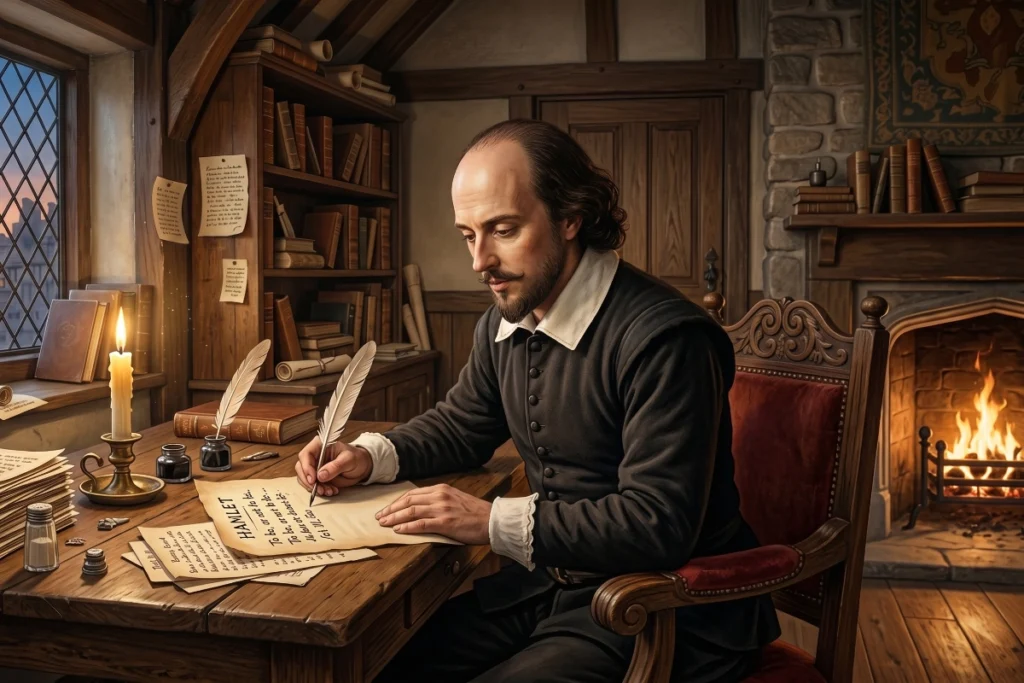
There is a persistent myth about creativity — that the truly original artist conjures something from nothing, that the great writer sits down with a blank page and, through the pure force of genius, produces something the world has never seen before. It’s a romantic idea. It’s also almost entirely untrue.
The greatest writers in the English language — Shakespeare, Dickens, Stevenson, Oscar Wilde — were, to a man, enthusiastic borrowers. They took stories from wherever they found them: from ancient myth, from history, from popular tales, from the works of their predecessors. They then did something extraordinary with what they found. They breathed new life into it. They made it speak to their own time, their own preoccupations, their own vision of what it means to be human.
This is not a lesser form of creativity. It is, in many ways, the highest form — the ability to take what exists and transform it into something that feels absolutely new. Understanding how the great writers did it is not just a fascinating journey through literary history. It’s an invitation to do the same thing yourself.
Shakespeare: the great borrower
Let’s begin with the most towering figure in the English literary tradition, and also, perhaps surprisingly, one of its most prolific borrowers. Shakespeare invented almost none of his plots. Romeo and Juliet comes from an Italian tale by Matteo Bandello, which had already been adapted by the English poet Arthur Brooke before Shakespeare got his hands on it. Hamlet derives from a Scandinavian legend. King Lear is based on a much older English chronicle. Othello comes from a novella by the Italian writer Cinthio. A Midsummer Night’s Dream draws on Ovid, Chaucer, and half a dozen other sources simultaneously.
Much Ado About Nothing — one of the most sparkling comedies in the English language — takes its central plot from Ariosto’s Orlando Furioso, an Italian epic poem written nearly a century before Shakespeare was born. The story of a young woman falsely accused of infidelity by her jealous lover was already old when Shakespeare found it. What he did with it — adding Benedick and Beatrice, sharpening the social comedy, deepening the emotional stakes — transformed a serviceable plot into one of the great theatrical experiences.
Shakespeare’s genius was not invention. It was transformation. He understood, with extraordinary intuition, which stories contained universal human truths, and he knew how to release those truths in a form that his audience could feel in their bones. The raw material was borrowed; the alchemy was entirely his own.
Why old stories keep returning
The reason writers have always returned to old stories is not laziness or lack of imagination. It’s something much more interesting: certain stories simply contain more truth than others. They encode, in narrative form, something fundamental about the human experience — about love, loss, jealousy, ambition, redemption, the tension between duty and desire. These stories have survived because they speak to something that doesn’t change across centuries and cultures.
The Greeks understood this. Their great tragedies — Oedipus, Antigone, Medea — were not new stories when Sophocles and Euripides wrote them. They were ancient myths that every member of the audience already knew. The playwrights weren’t telling the audience what happened; they were showing them why it matters. The power was not in the plot but in the telling.
Robert Louis Stevenson understood it too. Treasure Island draws on a long tradition of sea adventure and pirate lore — on Robinson Crusoe, on Captain Marryat’s naval novels, on the real history of buccaneers and privateers. Stevenson synthesised all of this into something that felt absolutely fresh, absolutely of its own moment, while being rooted in stories as old as the sea itself. He gave new life to old dreams of adventure and freedom, and in doing so created a story that has been giving life to new adaptations ever since.
Dickens and the novel of social conscience
Charles Dickens is another writer whose originality is sometimes overstated. His plots frequently drew on melodramatic theatrical traditions that were already well established — the foundling child, the hidden inheritance, the villain unmasked, the wronged woman, the heartless institution. These were the stock ingredients of popular Victorian fiction and theatre, familiar to every reader before Dickens opened his notebook.
What Dickens brought to these old ingredients was moral fire and extraordinary specificity of observation. He populated familiar narrative frameworks with characters of such vivid particularity — Scrooge, Fagin, Miss Havisham, Micawber, Jarndyce — that the frameworks disappeared and only the characters remained. He used the old stories of crime, poverty, and injustice to say something that had never quite been said before, in a way that changed how Victorian England understood itself.
A Christmas Carol is perhaps the purest example. The structure of a miser redeemed by supernatural intervention was ancient — it appears in folklore across dozens of cultures. Dickens took that old framework, placed it in the specific streets and counting houses of 1840s London, filled it with the specific social anxieties of his moment, and produced something that has been retold in every conceivable form ever since. The story was old; the telling made it eternal.
Oscar Wilde and the comedy of manners
Oscar Wilde is often thought of as utterly sui generis — so distinctive, so stylistically unique, that it seems impossible to locate him in any tradition. But The Importance of Being Earnest, for all its dazzling originality of voice, is firmly rooted in a theatrical tradition that stretches back through Sheridan and Congreve to the Restoration comedies of the seventeenth century. The comedy of manners — in which a sophisticated social world is held up to gentle but penetrating ridicule — was well over two hundred years old when Wilde sat down to write his masterpiece.
What Wilde added to this tradition was a philosophical playfulness that made the satirical point at a deeper level than any of his predecessors. His characters don’t just behave absurdly in a recognisable social context; they articulate the absurdity of their world in epigrams of such perfection that the comedy and the critique become indistinguishable. He gave new life to an old form by infusing it with a uniquely modern scepticism — a refusal to take anything quite seriously, including seriousness itself.
The adapters: giving old stories new stages
Beyond the great original writers lie the equally valuable adapters — those whose gift is taking a work that already exists and finding a new form, a new stage, a new audience for it. This is a tradition with as much honour attached to it as original writing, and it requires its own distinct set of skills.
The history of theatre is in large part a history of adaptation. Shakespeare’s plays have been adapted into operas, ballets, films, musicals, and forms that Shakespeare himself could never have imagined. West Side Story takes Romeo and Juliet and sets it in 1950s New York. The Lion King is Hamlet in animated form. Ten Things I Hate About You is The Taming of the Shrew in an American high school. Each of these adaptations asks the same question: what is the living truth in this old story, and how can I release it for a new audience in a new time?
The best adapters understand that fidelity to the letter of an original is less important than fidelity to its spirit. You don’t adapt Treasure Island by reproducing Stevenson’s novel word for word on a stage; you identify what is most alive in it — the moral complexity of Long John Silver, the coming-of-age arc of Jim Hawkins, the atmosphere of adventure and menace — and you find the theatrical means to release those qualities in your chosen form.
What this means for the tabletop stage
All of this has immediate and exciting implications for anyone working with a tabletop theatre. The classic plays and stories that lend themselves to a tabletop production — Shakespeare, Wilde, Stevenson — are themselves the products of this long tradition of borrowing, transforming, and renewing. They are not fixed monuments to be reproduced exactly; they are living stories that have been in continuous transformation for centuries, and there is no reason why that transformation should stop with you.
When you set up a tabletop production of Much Ado About Nothing or Treasure Island, you are not merely reproducing a classic. You are the latest in a long line of storytellers who have found something worth keeping in these works and chosen to pass it on. You have the same rights as every adapter before you: to change what doesn’t serve your audience, to emphasise what feels most alive, to find the moment where the old story and your own experience of the world connect.
Perhaps Benedick and Beatrice speak to something you recognise in the people around you. Perhaps Jim Hawkins’s courage in the face of overwhelming uncertainty resonates with something your children are going through right now. Perhaps the elaborate social games of The Importance of Being Earnest remind you of something very current about the way people perform their lives. Trust those recognitions. They are the point at which the old story meets the new telling, and they are where the life is.
You are part of the tradition
The great insight of literary history is that originality and tradition are not opposites. They depend on each other. Every original voice speaks out of a tradition, and every tradition is kept alive by original voices that find new things in it. Shakespeare needed Bandello and Ovid and the English chronicles; he also needed his own extraordinary mind and his own particular historical moment. The one without the other produces either imitation or chaos. Together, they produce art.
When you sit down to write your own play for a tabletop theatre — or when you pick up a character from a classic production and begin to tell its story in your own words — you are stepping into this tradition. You are doing what writers have always done: taking the stories that matter, finding what is alive in them, and giving that life to a new audience.
The stage is small. The tradition is enormous. And the story, as it always has been, is yours to tell.
Join us
At Create Theatre, we believe that great stories deserve to be told and retold, on every kind of stage, by every kind of storyteller. Our handcrafted tabletop theatres bring the classics within reach — and give you the stage to make them your own. Sign up below to be the first to hear when we launch, and to join a community of storytellers who love the living tradition of theatre.
Join the Create Theatre community — sign up for updates today.
Create Theatre in Your Life
www.CreateTheatre.com