
Hands, strings, and shadows: a guide to the world’s great puppetry traditions
Of all the theatrical arts, puppetry may be the most universal. Every culture on earth, as far as we know, has developed some form of it. From the shadow screens of Java to the glove stages of Taiwan, from the string theatres of Rajasthan to the seaside booths of the English coast, human beings have always found ways to breathe life into objects — to make the inanimate speak, move, and feel. The puppet is, in a sense, the most ancient actor.
What’s remarkable is not just how widespread puppetry is, but how varied. Each tradition has developed its own techniques, its own aesthetic, its own relationship between puppet, puppeteer, and audience. This guide is a tour through the most significant of those traditions — a chance to discover how differently the world has answered the same fundamental question: how do you bring a small figure to life?
Glove puppetry: the theatre in your hand
Glove puppetry — also known as hand puppetry or sleeve puppetry — is perhaps the most intimate of all puppet forms. The puppet fits over the puppeteer’s hand like a glove, with the forefinger inside the head and the thumb and middle finger operating the arms. Everything the puppet does flows directly from the puppeteer’s hand: a twitch of the wrist becomes a turn of the head, a spreading of the fingers becomes an expansive gesture of welcome or despair.
The glove puppet tradition is ancient and widespread. In Britain it gave us Punch and Judy, that riotous and occasionally alarming street theatre that has been performed on seaside beaches and at fairgrounds since the seventeenth century. Punch — descended from the Italian commedia dell’arte character Pulcinella — is one of glove puppetry’s great creations: anarchic, violent, irrepressible, and somehow beloved despite everything. The traditional Punch and Judy show, with its sausages and its policeman and its “That’s the way to do it!”, remains one of the most recognisable theatrical forms in the English-speaking world.
In China and Taiwan, glove puppetry developed into the extraordinary tradition of Bodehi — the “cloth sack theatre” whose history we explored in our recent article on Taiwanese puppetry. The Chinese and Taiwanese traditions emphasise a different quality from Punch and Judy’s boisterous comedy: they are capable of great delicacy, great drama, and great moral seriousness. The finest Bodehi performers can make their glove puppets move with a fluency that seems impossible, every gesture precisely calibrated to express character and emotion.
Glove puppetry also appears across India, where it is known in various regional traditions including in Kerala and Orissa. In Europe, different national traditions have produced their own glove puppet heroes: the German Kasperl, the French Guignol, the Greek Karagiozis (though this last is technically a shadow puppet who has absorbed some of the glove puppet tradition). All share the glove puppet’s characteristic energy, immediacy, and direct relationship with the audience.
Marionettes: the art of strings
If glove puppetry is the most immediate puppet form, marionettes are perhaps the most magical. A marionette is a puppet controlled from above by strings or wires attached to a wooden control bar held by the puppeteer. The puppet hangs below, its movements determined by the interplay of gravity and the puppeteer’s skill. When a marionette walks, runs, or dances convincingly, there is something genuinely uncanny about it — it seems to have a life that it shouldn’t possess.
The word “marionette” comes from France, where stringed wooden puppets were used in churches from the fifteenth century to re-enact scenes from the life of the Virgin Mary. “Little Mary” — Marion — gave her name to an entire tradition. The form spread across Europe and became one of the dominant theatrical entertainments of the pre-cinema age. Travelling marionette companies performed Shakespeare, opera, and popular drama to audiences across the continent for centuries.
The craft of the marionettist is formidable. A complex marionette may have a dozen or more strings, each controlling a different part of the body: head, shoulders, hands, knees, feet. The skill lies not just in controlling each string individually, but in creating the illusion of natural movement — the slight give in a knee as a foot lands, the sway of a head as a character looks around, the precise timing of a gesture that makes a speech feel inhabited rather than mechanical. The best marionettists spend years developing this skill, and the results can be breathtaking.
India has its own magnificent marionette traditions, most famously the Kathputli of Rajasthan — brightly painted figures carved from a single piece of wood, manipulated by strings tied to the puppeteer’s fingers rather than to a control bar. Kathputli performers are traditionally from the Bhat community, who have passed the craft down through generations, and their figures are among the most visually striking puppet forms in the world.
Shadow puppetry: theatre of light and dark
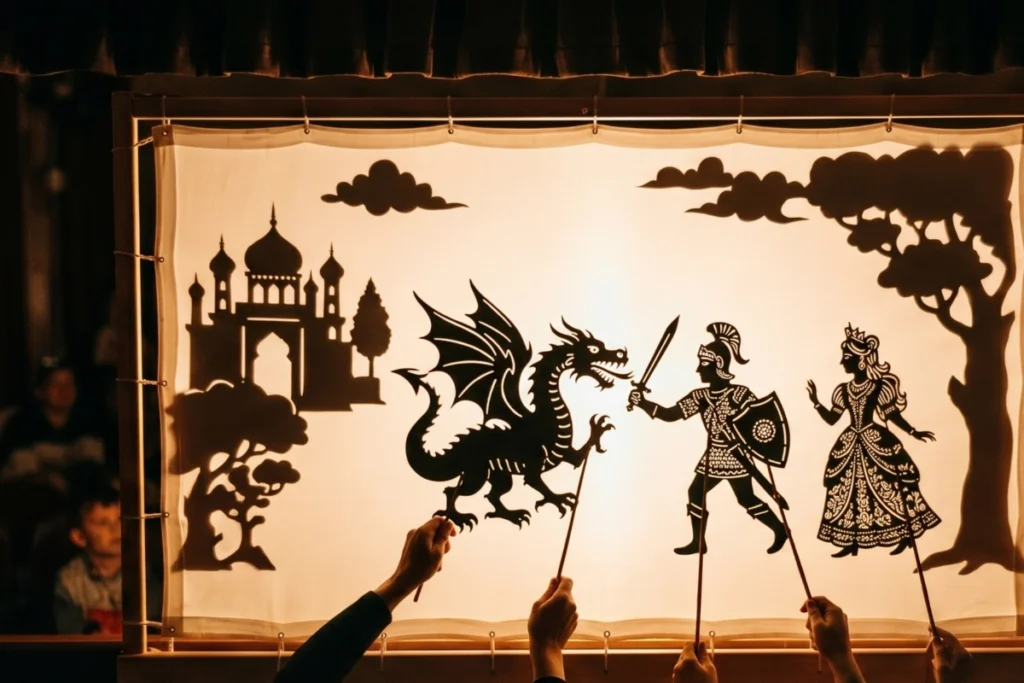
Shadow puppetry may be the oldest of all puppet traditions. Its essential mechanism is beautifully simple: a flat figure is held between a light source and a screen, casting a shadow that the audience sees from the other side. Everything else — the figure’s design, its manipulation, the stories it tells — varies enormously across cultures. But that fundamental relationship between puppet, light, and shadow is as old as firelight itself.
The oldest recorded shadow puppet tradition is the Wayang Kulit of Java and Bali in Indonesia, whose earliest references date from the ninth century. Wayang kulit shadow puppetry uses figures made from water buffalo hide, and is considered to be the oldest freestanding puppet form. The figures — elaborately carved and painted, their intricate perforations creating delicate patterns of light on the screen — are manipulated by the dalang, the master puppeteer, who also narrates the story, provides all the voices, and directs the accompanying gamelan orchestra. In the past, puppeteers were regarded as cultivated literary experts who transmitted moral and aesthetic values through their art. The words and actions of comic characters representing the “ordinary person” have provided a vehicle for criticising sensitive social and political issues. A traditional Wayang Kulit performance can last all night, telling stories from the Hindu epics — the Mahabharata and the Ramayana — that the audience knows intimately but never tires of hearing.
UNESCO designated Wayang puppet theatre a Masterpiece of Oral and Intangible Heritage, recognising its extraordinary cultural significance. It remains one of the great theatrical traditions of the world.
China has its own ancient shadow puppet tradition, dating back at least three thousand years. Chinese shadow puppets are typically made from treated animal hide — translucent, delicately carved, and painted in vivid colours that glow through the screen when lit from behind. The Chinese tradition spread with Chinese emigrants across Southeast Asia and beyond: shadow puppet shows were performed on the Australian goldfields in the nineteenth century by Chinese workers on the transcontinental railway, and the tradition took root in Indonesia, Malaysia, Singapore, and Taiwan.
In Turkey and Greece, shadow puppetry developed the comic character of Karagöz — a quick-witted, irreverent trickster figure whose sharp tongue and satirical energy made him a vehicle for social commentary that official culture couldn’t easily silence. The Karagöz tradition is another reminder that puppet theatre, across many cultures, has served as a space for saying what might otherwise be unsayable.
Bunraku: the supreme art of the puppet
If you wanted to make the case that puppetry can achieve anything that human actors can — and perhaps some things they cannot — you would point to Bunraku, the traditional puppet theatre of Japan. Bunraku is recognised as a UNESCO Intangible Cultural Heritage. Bunraku puppets are about one-half life size and each is operated by three performers: a principal operator and two assistants. Strings are not used, but rather the puppeteers co-operate to manoeuvre the limbs, eyelids, eyeballs, eyebrows and mouths of the puppets, thereby producing life-like actions and facial expressions.
The three puppeteers work in complete silence and extraordinary synchrony. The principal operator, who has usually spent a decade learning to control only the feet and legs before being trusted with the more expressive upper body, controls the head and right arm. The two assistants manage the left arm and the legs respectively. The result, when it works — and in the hands of masters it always works — is movement of such fluidity and expressiveness that the audience forgets entirely that they are watching three men in black manipulating a wooden figure.
The story is narrated by a single person, who also speaks the voice of all the puppets, and therefore must have a diverse repertoire of vocal expressions to represent both genders and all ages. This narrator, accompanied by a shamisen player, provides all the emotional texture of the performance — the grief, the joy, the fury — while the puppeteers provide the physical life. It is a theatre of exquisite collaboration.
Bunraku as we know it today, combining puppetry, joruri and musical accompaniment provided by the three-stringed shamisen, began in the Edo Period (1600–1868) in Osaka. Like kabuki, in the 1600s bunraku became the common man’s equivalent of the noh, which only the aristocracy were allowed to study. Classic tragic love stories, heroic legends, and tales based on historical events remain the core of the Bunraku repertoire — stories of human passion told with a beauty and precision that has moved audiences for four centuries.
Rod puppetry: control from below
Rod puppets are controlled from below by rods attached to the head and limbs of the figure. Unlike marionettes, which hang from above and are subject to gravity’s grace, rod puppets are pushed upward — supported and animated by the puppeteer’s hands beneath the stage, invisible to the audience above.
The rod puppet tradition is particularly rich in Asia. In West Bengal and Orissa in India, rod puppetry — known as Putul Nautch, or “puppet dance” — has a history stretching back to the fourteenth century, with performances rooted in the traditions of the Ramayana and Mahabharata. The Indonesian Wayang Golek is a three-dimensional rod puppet form from West Java, its figures carved from wood and dressed in elaborate costumes, used to tell both Hindu epics and Islamic stories.
In the twentieth century, rod puppetry found a new global audience through television. The Muppets — perhaps the most beloved puppet characters of the modern era — are essentially rod and arm puppets, with the puppeteer’s hand inside the head controlling the mouth while rods or a second hand operate the arms. Jim Henson’s genius lay partly in understanding what this mechanism could do for comedy and character: the Muppet style allows for extraordinary expressiveness of face and gesture, creating characters of genuine warmth and individuality. Kermit the Frog, Miss Piggy, and Fozzie Bear are as vivid and fully realised as any character in live-action television — which is a remarkable achievement for puppets operated by hand.
Ventriloquism: the puppet without a stage
Ventriloquism is the most portable of all puppet traditions — it requires no stage, no screen, no special lighting, only a performer and a figure small enough to sit on a lap or in a bag. The ventriloquist’s art is the illusion of a voice that appears to come from somewhere it doesn’t: from the dummy, not the performer. The word comes from the Latin for “stomach-speaking” — a reference to the ancient belief that ventriloquists threw their voices from their abdomen.
The ventriloquist dummy has become one of the most recognisable puppet forms in the world: a hard-headed figure with a hinged jaw, usually dressed as a cheeky boy or a suited gentleman, whose relationship with its operator is typically one of gleeful insubordination. The dummy says what the ventriloquist won’t. It insults, contradicts, and embarrasses — and the audience loves it, because there’s something deeply satisfying about watching a small figure get the better of a large one.
The tradition has produced some memorable double acts. Charlie McCarthy, the monocled dummy of the American ventriloquist Edgar Bergen, was a genuine celebrity in the 1930s and 40s, appearing on radio — absurdly, for a visual act — to enormous success. More recently, ventriloquism has enjoyed a significant popular revival through performers who have found new ways to use the form, demonstrating that its essential appeal — the intimacy between performer and figure, the comedy of a voice that seems to come from nowhere — is as fresh as it ever was.
Body puppetry and the modern stage
The twentieth century saw the development of new puppet forms that blur the line between puppetry and other theatrical arts. Body puppetry — in which the performer’s own body becomes part of or entirely enclosed within the puppet — has produced some of the most spectacular theatrical images of recent decades. The enormous figures of the street theatre company Graeae, the life-size horses of War Horse (operated by multiple visible puppeteers in the Bunraku tradition), and the giant street puppets of companies like Royal de Luxe, who have paraded enormous mechanical figures through cities across the world, have all demonstrated that the puppet form can operate at any scale and in any context.
What unites all of these forms — from the glove puppet on a beach to the giant mechanical figure in a city street — is the essential act of puppetry: the transfer of life from human hands to inanimate object. We know the puppet isn’t alive. We know the strings are there, the hand is inside, the operators are visible. And yet we believe, for the duration of the performance, that this thing is alive — that it feels, wants, suffers, and rejoices. That willing suspension of disbelief, that gift the audience gives the puppeteer, is one of the most generous and mysterious acts in all of theatre.
The miniature stage
At Create Theatre, our handcrafted tabletop theatres are part of this long and rich global tradition. The toy theatre — performing classic plays on a miniature stage, with figures moved by hand — sits naturally alongside glove puppetry, shadow theatre, and all the other forms that have placed small figures at the centre of large stories. Whatever the scale, whatever the tradition, the essential magic is the same: a human being, a figure, and a story worth telling.
Sign up below to join the Create Theatre community and be the first to hear when we launch.
Join the Create Theatre community — sign up for updates today.
Create Theatre in Your Life
www.CreateTheatre.com