
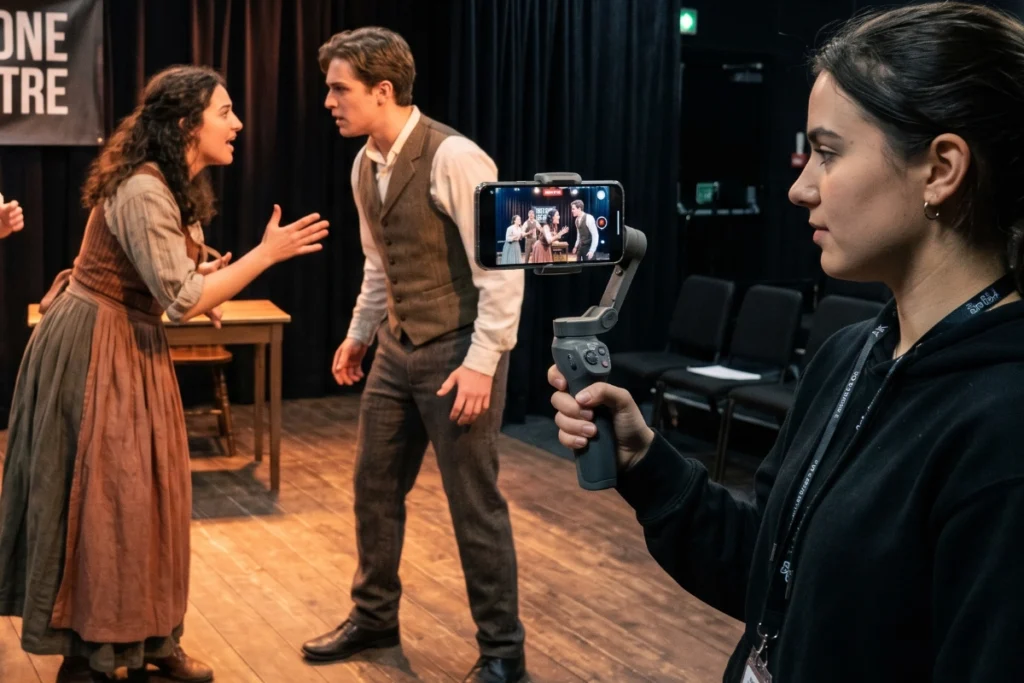
Watching yourself back: the art of recording and reviewing your performance
There is a moment that almost every performer knows and dreads in equal measure: the first time you watch yourself back on film. The voice that sounds nothing like the one you hear in your head. The gesture you were certain was subtle and that turns out to be enormous. The expression you intended as thoughtful that reads, on screen, as simply blank. It is, for most people, a deeply uncomfortable experience.
It is also one of the most valuable tools available to any performer.
Recording and reviewing your own performances — whether on a professional stage, in a drama class, at a rehearsal, or at a tabletop theatre with a phone propped against a stack of books — is a practice that separates performers who improve steadily from those who plateau. The gap between how we think we appear and how we actually appear is one of the most persistent obstacles in performance, and the only reliable way to close it is to look.
This article is a guide to doing that well: how to record your performances usefully, how to review them productively, and how to turn what you see into genuine improvement without falling into the trap of pure self-criticism that makes the whole process counterproductive.
Why we struggle to see ourselves clearly
Before we talk about how to review a performance, it’s worth understanding why we find it so difficult in the first place. The discomfort of watching yourself on film isn’t just vanity or self-consciousness — it has deeper roots in how we experience ourselves from the inside.
When you perform, you are entirely absorbed in the doing of it. You are tracking your lines, managing your physical presence, responding to other performers, gauging the audience’s reaction, making a hundred micro-decisions every minute. You are, necessarily, experiencing the performance from the inside — from behind your own eyes, feeling what your character feels, inhabiting the moment as it passes. That is, of course, exactly what good performance requires.
But it means that your memory of a performance and the objective reality of it are often quite different things. You remember how it felt — the confidence that surged in the second scene, the moment you were sure you’d lost the audience, the line that landed exactly as you’d hoped. What you don’t have is any reliable sense of how it looked — how your body occupied the space, whether your voice was as clear as it felt, whether your stillness read as presence or absence.
Recording gives you access to what the audience experienced. That’s an uncomfortable gift, but it is a gift.
How to record effectively
The value of a recording depends enormously on its quality. A shaky video taken on a phone at the back of a hall, with inaudible sound and a frame so wide that the performers are indistinguishable specks, will tell you almost nothing useful. A little thought and preparation before you record can make the difference between footage that genuinely illuminates your work and footage that simply confirms that something happened.
Sound is the most important element to get right, and the most frequently neglected. The built-in microphone on a phone or tablet is almost always inadequate for recording performance — it captures the ambient sound of the room rather than the performers’ voices, and the result is often so muddy as to be useless for voice work. If you are serious about reviewing your vocal performance, investing in a simple external microphone — even an inexpensive clip-on lavalier that connects directly to your recording device — will transform the quality of what you capture. Alternatively, placing the recording device much closer to the performers than feels natural will capture voice much more reliably than recording from a distance.
For visual recording, the key questions are framing and position. A full-body shot gives you the most information about physical performance — posture, gesture, movement, the use of space. A closer shot gives you more information about facial expression and subtlety of delivery. For a review session, it’s worth having both if possible: a wide shot from front-of-house that captures the full picture, and a closer shot that lets you examine detail. Two devices recording simultaneously from different angles is ideal; one well-positioned device is perfectly adequate.
Lighting matters more than most people expect. A performer shot against a bright window, or under harsh overhead light that casts deep shadows, is much harder to read than one shot in good, even illumination. If you’re recording in a rehearsal room or at home, take a moment to consider the light source and whether it’s working for or against you.
For tabletop theatre specifically, the recording challenge is slightly different. You are capturing both the performer — often partially visible above or beside the stage — and the stage itself, which is the primary visual field. A slightly elevated angle that takes in both the stage picture and the puppeteer’s hands works well, and again, close microphone placement is essential if you want to review the vocal performance alongside the physical.
Creating the right conditions for review
How you watch your recording matters as much as the recording itself. The wrong conditions — watching on a small phone screen immediately after the performance, exhausted and still full of adrenalin, with other people offering unsolicited commentary — tend to produce either defensive dismissal or disproportionate self-criticism. Neither is useful.
Leave some time between the performance and the review if you can. Twenty-four hours is ideal; even a few hours creates useful distance. You will watch more objectively when you are not still emotionally inside the performance you’ve just given.
Watch on the largest screen available to you. A laptop or tablet is significantly better than a phone. A television screen is better still. The more clearly you can see what’s happening, the more useful the review will be.
Watch through once without stopping. This is important. The temptation is to pause at the first thing that makes you wince and spend ten minutes on it before moving on — but this destroys your sense of the performance as a whole, and the whole is what an audience experiences. Watch it through as if you were a member of the audience. Notice your overall impressions. Does it hold your attention? Where does your focus wander? What are the high points? Only then go back and look at specific moments in detail.
Take notes, but be structured about what you note. A review session that produces a long list of everything you did wrong is demoralising and not particularly useful — you can’t fix everything at once, and trying to will make you self-conscious in a way that inhibits rather than improves performance. A more productive approach is to focus each review session on two or three specific questions, and to note both what’s working and what needs attention.
What to look for
A structured approach to reviewing your own performance prevents the session from becoming either a celebration of what went well or an extended exercise in self-punishment. Here are the areas that are most consistently revealing and most productively addressed through recorded review.
Voice is often the biggest revelation. How clearly are you speaking? Is every word landing, or are endings swallowed and consonants lost? Is your pace serving the material — giving the audience time to absorb what they’ve heard — or are you rushing through the moments that need space? Is there variety in your vocal delivery, or does a single register creep in and flatten the performance? Listen to your recording with your eyes closed if it helps: strip away the visual and just hear what the audience hears.
Physical presence is the second great area of discovery. How do you use the space? Do you fill it confidently or hover at its edges? Are your gestures clear and purposeful or vague and habitual — the repeated push of hair back from the face, the unconscious shoulder hunch, the swaying that you had no idea you were doing? Is your stillness genuinely still, or does a low-level fidget undermine it? The body is extraordinarily expressive, and equally extraordinary in its capacity to express things we didn’t intend.
Pacing and rhythm are harder to assess from inside a performance than almost anything else. What felt like a pregnant pause may have been an awkward gap. What felt like a nicely varied pace may read as erratic. The recording allows you to hear the actual rhythm of the performance — the breathing room you gave or didn’t give to the key moments, the energy level across the arc of the piece, the moments where things sagged or rushed.
Listening and responsiveness — particularly in ensemble performance — is one of the most telling things to look for. Are you genuinely responding to the other performers, or going through predetermined motions? Is your attention visibly alive between your own lines? An audience can see exactly how much you’re listening, and a performer who visibly isn’t is always the weakest element in a scene, regardless of how well they deliver their own lines.
Turning observations into improvement
The purpose of a review session is not to produce a verdict on a performance — it’s to generate specific, actionable insights that can be taken back into rehearsal or practice. The question at the end of every review session should not be “was that good or bad?” but “what specifically will I do differently next time, and how will I practise it?”
Be concrete. “I need to be more present” is not an actionable note — it doesn’t tell you what to do differently. “I need to pause for three beats after that line rather than moving immediately” is actionable. “My voice drops at the end of sentences — I’ll work through the text marking every sentence ending and practise keeping the energy up” is actionable. The more specific the note, the more useful it is.
Prioritise. Choose the two or three things that will make the most difference and focus your rehearsal energy there. Everything else can wait. A performer who addresses two significant issues between performances will improve more reliably than one who tries to address twenty minor ones simultaneously and addresses none of them properly.
Return to the recording after you’ve worked on something. This is the step that most people skip, and it’s the most revealing. Did the adjustment you made actually translate to the screen? Is the change visible and audible, or have you replaced one habit with another? The review process is most powerful when it’s genuinely iterative — when each cycle of record, review, adjust, and record again builds towards a progressively clearer and more controlled performance.
The psychological dimension
None of this is psychologically straightforward. Watching yourself perform requires a particular kind of self-awareness that sits in uncomfortable tension with the self-forgetfulness that the best performance demands. Too much self-consciousness on stage or camera is deadly — it produces performers who are watching themselves rather than inhabiting the character, who are managing their image rather than telling the story.
The solution is to be ruthlessly honest in the review room and ruthlessly unselfconscious in the performance. The review session is where you do the analytical work; the rehearsal and performance is where you let it go and trust that the work has been absorbed. This is a discipline that takes time to develop, but it is learnable — and the performers who develop it improve faster and more sustainably than those who either avoid self-review entirely or carry it with them onto the stage.
It also helps to cultivate the habit of reviewing your best moments as carefully as your worst ones. What specifically made that scene work? What were you doing physically, vocally, and emotionally in the moments that landed most powerfully? Understanding what good looks and sounds like in your own performance is at least as valuable as understanding what doesn’t work — and considerably more encouraging.
Recording at the tabletop theatre
For performers working with a tabletop theatre, the recording and review process has its own particular value. Tabletop performance combines the vocal demands of radio drama with the physical demands of puppetry — the manipulation of figures, the management of the stage picture, the coordination of voice and movement — and all of these elements benefit from the objective eye of a camera.
Watching back a tabletop performance often reveals things about the relationship between the puppeteer’s hands and the figures’ apparent life that are almost impossible to perceive in the moment. Is the figure truly inhabiting the space — standing, moving, turning with conviction — or are the movements tentative and mechanical? Is the voice coming from the figure’s direction, creating the illusion that it’s the source of the sound, or is the vocal performance disconnected from the physical one? These are the specific craft questions of tabletop theatre, and a recording answers them with a clarity that no amount of in-the-moment awareness can match.
For families and young performers using a tabletop theatre at home, the recording process also has a wonderful additional dimension: it creates a record of something genuinely worth keeping. Performances that might otherwise exist only in memory can be saved, shared, and returned to. Children who watch themselves back — often after initial reluctance — are frequently surprised by what they’ve made, and that surprise has its own value: the discovery that you have made something real, something that exists in the world, something worth seeing.
Start simple, keep going
You don’t need professional equipment, a formal review process, or a drama teacher to begin. You need a recording device, a willingness to watch yourself honestly, and the discipline to take what you see back into your next rehearsal or performance. Start with one question — “is my voice clear?” or “am I still when I need to be?” — and build the practice from there.
The performers who improve most consistently are almost always those who watch themselves most honestly. The discomfort of that first viewing fades quickly. What remains is something genuinely useful: the ability to see your own work clearly, and to keep making it better.
Join us
At Create Theatre, we believe that every performance — however small the stage — deserves the care and attention that comes from genuine reflection. Our handcrafted tabletop theatres give you the stage; the camera gives you the mirror. Sign up below to join our community and be the first to hear when we launch.
Join the Create Theatre community — sign up for updates today.
Create Theatre in Your Life
www.CreateTheatre.com